


25/09/2026
A series of major infrastructure projects are being rolled out from North to South, expanding urban space, connecting economic hubs and creating new room for growth in Vietnam’s real estate market.
Since the beginning of 2026, a series of large-scale infrastructure projects have been launched nationwide, spanning railways, airports, expressways and seaports. Individual projects are gradually being connected into an integrated network that not only shortens geographical distances but also creates new room for reorganizing urban, production and real estate spaces.
Infrastructure Accelerates
By early September, more than VND 513.3 trillion in public investment capital had been disbursed, equivalent to 50.2% of the plan assigned by the Prime Minister. Notably, this figure reflects the scale of resources being channeled into infrastructure projects, effectively turning the country into a vast network of mega infrastructure construction sites stretching from North to South, with projects closely interconnected.
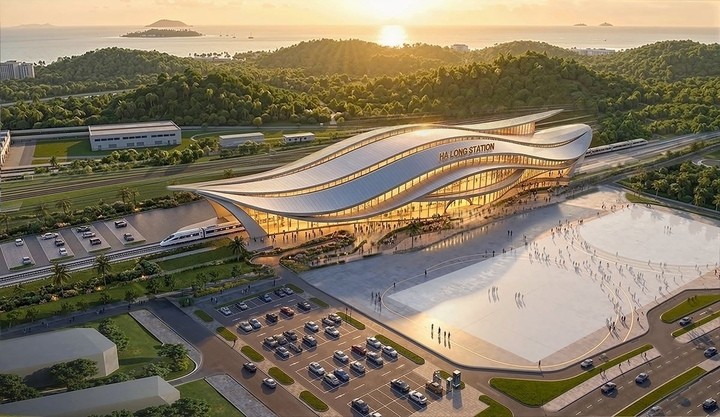
Artist’s impression of Ha Long Station, part of the Hanoi–Quang Ninh high-speed railway.
Several major projects are currently drawing particular public attention. In the North, construction has begun on the Hanoi–Quang Ninh high-speed railway. The 120.2-kilometer line will pass through Hanoi, Bac Ninh, Hai Phong and Quang Ninh, with total investment exceeding VND 147 trillion. The project is being developed by VinSpeed High-Speed Railway Investment and Development JSC, a subsidiary of Vingroup, with a designed maximum speed of 350 km/h and a maximum speed of 120 km/h on the section passing through Hanoi. Once completed, the railway is expected to cut travel time between Hanoi and Quang Ninh to just 23 minutes.
In the same region, the Lao Cai–Hanoi–Hai Phong railway will create an additional connectivity axis running from the Northwest to the Southeast. The main line will be approximately 390.9 kilometers long, with branch lines totaling about 27.9 kilometers, passing through Lao Cai, Phu Tho, Hanoi, Bac Ninh, Hung Yen and Hai Phong, connecting the border area with Lach Huyen Port. Total investment is estimated at more than VND 203.2 trillion. The project will be funded by public investment capital and is targeted for completion no later than 2030.
In Central Vietnam, Da Nang has launched the overall investment and construction project for Lien Chieu Container Port, with total investment exceeding US$2 billion. The project is identified as a major seaport infrastructure development aimed at expanding logistics capacity in the Central region.
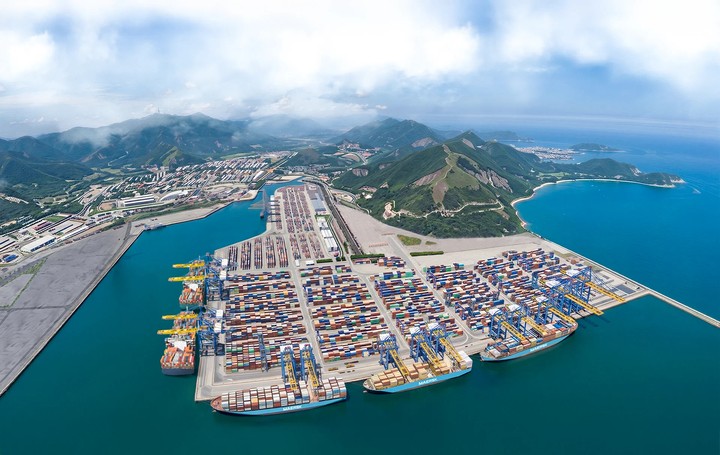
Artist’s impression of Lien Chieu Container Port.
In the South, Long Thanh International Airport is another link illustrating the trend toward network-based infrastructure investment. By the end of June, the project’s overall output value had reached approximately 77% of the contract value. The Government has set a target of putting the airport into commercial operation in December.
To serve the airport, the Ministry of Construction said that six road projects are currently under implementation, including the Ben Luc–Long Thanh Expressway, Bien Hoa–Vung Tau Expressway, expansion of the Ho Chi Minh City–Long Thanh–Dau Giay Expressway, Ring Road No. 3 of Ho Chi Minh City, and the DT25C and DT25B provincial roads. Long Thanh is therefore being positioned within a connectivity network linking Ho Chi Minh City with neighboring economic centers, rather than being viewed merely as an isolated airport project.
In Ho Chi Minh City, the southern area is seeing additional projects that could reshape regional connectivity over the long term. On July 1, Vingroup broke ground on an offshore road connecting Can Gio with Vung Tau, with total investment of approximately VND 93.159 trillion (US$3.6 billion). This is the first direct transport corridor connecting Can Gio with the region’s major tourism center and largest seaport, opening up new opportunities for seaward-oriented development and promoting the marine economy, tourism and logistics in Can Gio.
Previously, in December 2025, the Ben Thanh–Can Gio high-speed railway project was also launched, reducing travel time from central Ho Chi Minh City to Can Gio to just 13 minutes.
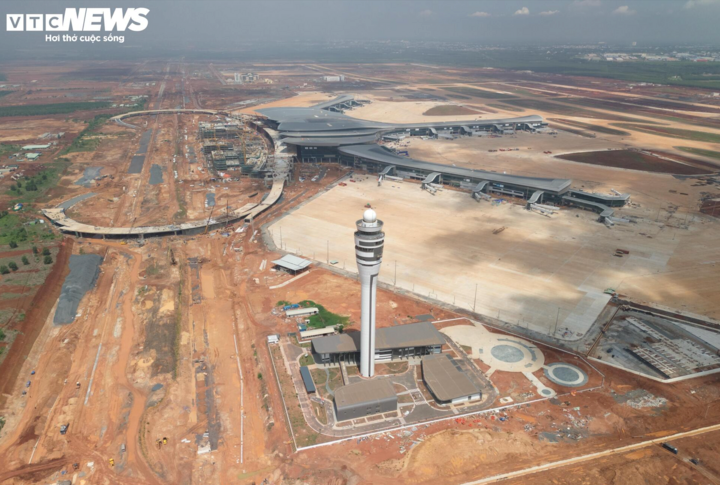
Long Thanh International Airport is expected to begin commercial operations in December 2026.
Also in Can Gio, the Can Gio International Transshipment Port project has received in-principle investment approval from Ho Chi Minh City, with a total scale of approximately VND 128 trillion. Phase 1 is expected to be developed on an area of 571 hectares, with a capacity of 4.8 million TEUs per year by 2030; the project’s total designed capacity is set at up to 16.9 million TEUs.
New Urban Areas Are Taking Shape
It is evident that infrastructure investment is increasingly being directed toward strengthening connections among economic centers, urban areas, airports, seaports and production corridors, rather than simply addressing transportation needs within individual localities. This is also laying the groundwork for infrastructure to have a deeper impact on how the real estate market takes shape and shifts.
According to experts, for real estate, the greatest impact of infrastructure does not lie in the appearance of a new road on the map, but in its ability to change a location’s relationship with employment centers, production areas, services, logistics hubs and urban centers.
For example, when an airport is connected to an expressway, and that expressway in turn connects to a seaport and production centers, the catchment area accessible to residents and businesses expands. As a result, areas previously outside the scope of urban development may gain better conditions to meet demand for housing, commercial space, services, warehousing and production.
Dr. Architect Vo Kim Cuong, former Deputy Director of the Ho Chi Minh City Department of Planning and Architecture, said the purpose of planning is to ensure balanced, stable development and harmonized interests. In this context, technical infrastructure serves as the “skeleton” of the development space.
According to him, what is particularly noteworthy at present is that the State is implementing a series of large-scale and coordinated projects, creating a catalyst for the implementation of national and urban development plans. “Only an integrated infrastructure system can fully realize its functions and ensure investment efficiency,” he said.
However, for an area to truly develop into an urban center or growth pole, infrastructure is only a necessary condition. According to Dr. Architect Vo Kim Cuong, three additional groups of conditions are required: natural conditions, market conditions and government intervention.
This also explains why a newly built road cannot automatically be assumed to trigger real estate development along both sides. Market supply and demand, together with the ability to organize and plan development and attract actual residents and visitor flows, ultimately determine whether economic and urban activities can take shape. Urban areas that can access and address development demand for housing, offices, commercial space, services and other needs have the potential to become new growth poles.
*“Having new infrastructure is one of the three fundamental conditions for the formation of an urban area,”* he explained.
According to the expert, infrastructure creates new development capacity for land and can increase land values. However, if this capacity is not put to use in a timely manner, the market can be affected by speculation, while speculators may benefit from the broader development process of society.
Therefore, the important factor is not only infrastructure construction but also the organization of development after the infrastructure has been established.
Dr. Architect Vo Kim Cuong said the State plays an important role because it can capture information on supply and demand, set strategic development directions and mobilize social resources. Through planning, financial instruments, land fund management and development orientation based on the TOD model, the State can take a more proactive approach to harnessing the new capacity created by infrastructure.
From this perspective, the impact of an infrastructure project on real estate depends on whether the project creates new economic capacity and attracts residents, businesses, jobs and new services.
An area with an airport but inadequate connectivity may not be able to fully realize its potential. A road passing through a large tract of land without sufficient market demand may also be insufficient to create an urban area. Conversely, when infrastructure is developed in a location with favorable natural conditions, market demand and appropriate development policies, the potential for a new growth pole to emerge is greater.
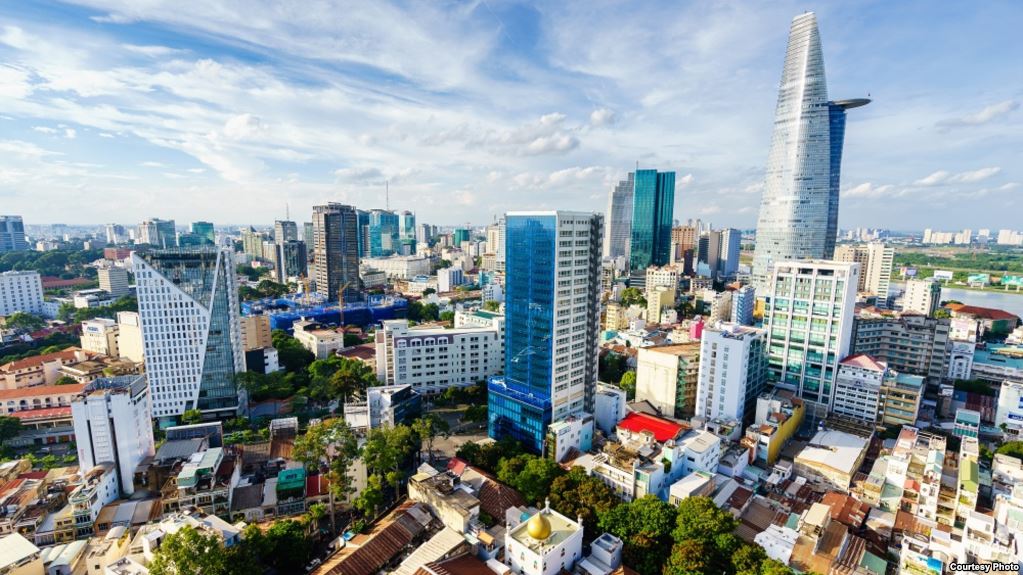
A series of major infrastructure projects are being rolled out from North to South, creating new room for growth in Vietnam’s real estate market.
In practice, some projects today are also demonstrating more systematic planning and development by implementing infrastructure investment alongside residential urban development and tourism and resort destinations.
Notable examples include the Transit-Oriented Development (TOD) model at Vinhomes Global Gate Ha Long (Quang Ninh) and Vinhomes Green Paradise (Can Gio, Ho Chi Minh City). Here, high-speed railway stations are planned within the projects themselves, combined with an ecosystem of residential and office spaces and a wide range of entertainment and resort amenities such as theaters, golf courses and amusement parks. These developments are expected to attract large numbers of residents as well as steady flows of tourists, forming new growth poles.
More broadly, urban planning experts believe that over the next 10–15 years, key infrastructure could create conditions for the formation and development of numerous new urban areas. If projects are implemented in a coordinated manner, on schedule, and in alignment with appropriate planning, market conditions and development policies, infrastructure could become a foundation for expanding urban space and creating additional growth poles.

 Zalo
Zalo Webchat