


Over the past ten years, apartment prices in central Ho Chi Minh City have increased nearly threefold, ranking among the highest growth rates across all real estate segments, according to data from Batdongsan.
Speaking at the Ho Chi Minh City Real Estate Forum themed “Central Core” on November 18, Nguyễn Quốc Anh, Deputy CEO of Batdongsan (an online real estate marketplace under PropertyGuru Group), said that all property segments in the city center have experienced significant price appreciation over the past decade.
Apartment prices rose on average three times, from VND 31 million per square meter in 2015 to VND 92 million, second only to land plots, which increased 4.8 times. The growth rate of condominium prices in the core area of Ho Chi Minh City also outpaced that of landed properties (private houses and shophouses), which rose 2.3–2.7 times.
Despite rising prices, demand for apartments in the central area remains high. In the first nine months, central districts accounted for around 28% of total supply but attracted up to 45% of the search demand in the former Ho Chi Minh City area.
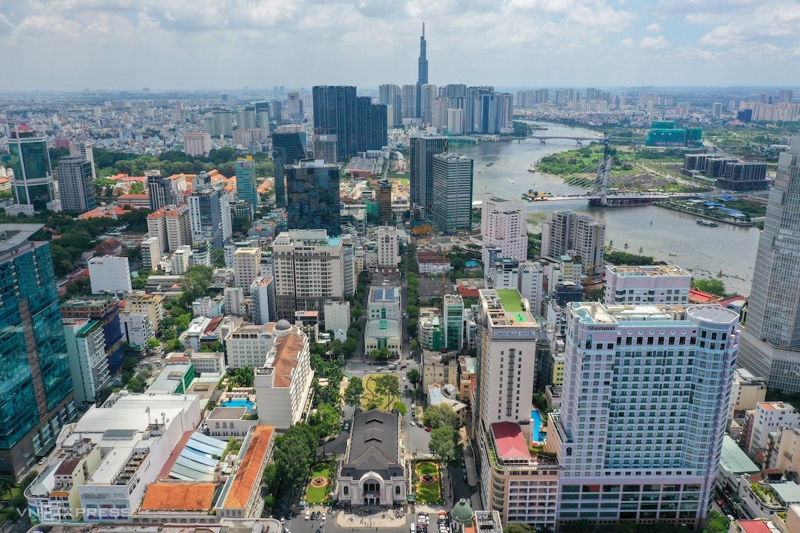
Real Estate in Ho Chi Minh City Center
According to Nguyễn Quốc Anh, the combination of “undersupply,” “excess demand,” and the depletion of new supply has put upward pressure on existing apartment prices. Moreover, the city center, as the core hub of commerce, finance, and services with high employment density and well-developed public transport, consistently maintains high property values and limited supply.
He added that the concept of the “city center” is gradually expanding toward Thủ Thiêm, which is planned to become Ho Chi Minh City's future international financial district.
With rapid changes in regional urban structures, the definition of the city center is increasingly based on functional criteria rather than traditional geographical boundaries. A district is considered a central area when it meets quantifiable factors such as infrastructure development speed, zoning plans, business density, job attractiveness, FDI inflows, connectivity, and the formation of new functional clusters.
This expansion toward Thủ Thiêm has driven the area to lead the entire market in price growth over the past year. According to Batdongsan, as of Q3, apartments in Thủ Thiêm and Nam Rach Chiec were priced between VND 80–120 million per square meter, increasing 32–48%. The area now accounts for more than 60% of the city’s total supply, mostly comprising high-end units priced above VND 100 million per square meter.
A report from Dat Xanh Services’ Real Estate Research Institute also confirmed this trend, showing that Thủ Thiêm — planned as the new financial hub — saw price increases of 15–30% compared to earlier this year. Avison Young Vietnam reported annual price growth of 18–27% in the Thủ Thiêm New Urban Area, significantly higher than the 13–19% growth in Thao Dien (former) and Thanh My Loi (former), second only to District 1 before consolidation.
In the long term, central Ho Chi Minh City real estate will continue to attract investors over the next 5–10 years, though its growth potential is expected to slow as prices in old central districts have become too high and supply remains limited. Meanwhile, the expanding definition of the central zone is creating new investment hotspots, offering opportunities but also intensifying pressure on older central areas.
Experts recommend that homebuyers adopt a long-term investment perspective rather than focusing excessively on the traditional central districts. Buyers should consider projects in well-planned areas near major transport corridors to achieve stable returns and higher appreciation potential.

 Zalo
Zalo Webchat