


Resale apartment prices have stagnated, while rising interest rates are putting pressure on homeowners whose principal grace periods have expired, forcing them to lower asking prices.
According to a survey by VnExpress, Hanoi’s secondary apartment market began to plateau late last year, with some suburban projects even seeing “cut-loss” sales of several hundred million VND.
In its recently released Q1 report, real estate services firm CBRE noted signs of cooling in Hanoi’s resale apartment market. The average selling price reached VND 62 million per square meter, unchanged from the end of Q4/2025. However, on a year-on-year basis, prices have increased by 21%.
CBRE observed that price growth in the secondary apartment segment has slowed significantly since late last year. By the end of Q1, more than half of the projects tracked in the secondary market recorded either declining asking prices or remained flat compared to the previous quarter.
Ms. Nguyen Hoai An, Senior Director of CBRE Hanoi, said this adjustment is necessary following a prolonged period of strong price increases in the apartment segment, which has challenged affordability for end-users. She added that this period also coincides with a group of homeowners reaching the end of their principal grace periods (mainly in under-construction projects). Amid fluctuating interest rates exerting pressure on liquidity, “they are compelled to accept lower asking prices to secure transactions.”
This trend has also been recorded by the Vietnam Association of Realtors (VARS). The association noted that homebuyer sentiment has become more cautious compared to previous periods. Market liquidity is no longer broad-based but has shifted toward selectivity, clearly reflecting capital flow segmentation.
A survey by VARS’ research council shows an increasing volume of inventory needing to be offloaded, especially among investors using financial leverage. Some projects (apartments and low-rise housing) have recorded losses of approximately VND 100–300 million per unit. In many previously overheated areas, prices have plateaued or slightly adjusted downward, increasing psychological pressure on investors. This group had previously entered the market easily with initial capital of only 10–30% of property value, expecting short-term gains of several hundred million to over a billion VND.
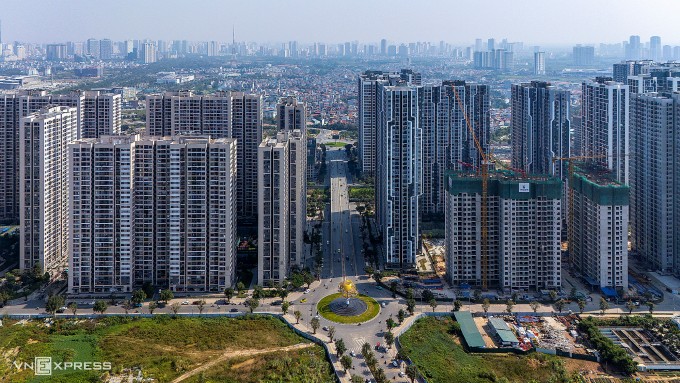
In contrast to the stagnation in the secondary market, newly launched apartments continue to rise and remain at high levels. CBRE reported that the average primary market price in Hanoi reached VND 102 million per square meter, up 29% year-on-year. This level even exceeds that of Ho Chi Minh City (prior to administrative merger), where average apartment prices stood at VND 91 million per square meter during the same period.
“This marks the third consecutive quarter in which primary apartment prices in the capital have remained above VND 100 million per square meter,” CBRE noted, adding that the upward trend has expanded to suburban areas such as Gia Lam and Dong Anh, traditionally known for mid-range supply. These areas have now seen new launches priced above VND 100 million per square meter, even approaching VND 150 million.
Explaining this trend, Ms. Nguyen Hoai An stated that rising input costs—including land lease and land-use fees, site clearance compensation, financing costs, and construction materials—have significantly increased, and these factors are fully reflected in developers’ launch prices.
Regarding the resale market, Mr. Pham Duc Toan, CEO of EZ Property, said that demand for both owner-occupiers and investors has declined due to rising lending interest rates and elevated price levels, leading to weaker absorption rates. He noted that if the divergence between primary and secondary markets continues to widen, buyers will increasingly shift toward more affordable resale properties. This trend will make high-end and luxury inventory less attractive and more difficult to absorb, increasing the risk of unsold stock.
Looking ahead, CBRE forecasts that the apartment market will become increasingly competitive as developers step up incentive policies to attract buyers. Total new supply this year is expected to reach approximately 36,000 units, similar to last year. “Buyers will have more options, take longer to make decisions, and impose stricter requirements,” Ms. Nguyen Hoai An said, adding that advantages will favor projects with strong quality, appropriate pricing, and sales policies aligned with real demand.
The CEO of EZ Property also recommended that developers restructure their product offerings to better match end-user demand, gradually bringing housing prices to more reasonable levels, while diversifying funding sources. “This is considered a key factor in unlocking cash flow and expanding real demand amid tightened real estate credit conditions,” he said.

 Zalo
Zalo Webchat