


28/01/2026
On January 27, during its 31st session, the Hanoi People’s Council approved a Resolution on adjustments to the Housing Development Program of Hanoi for the 2021–2030 period.
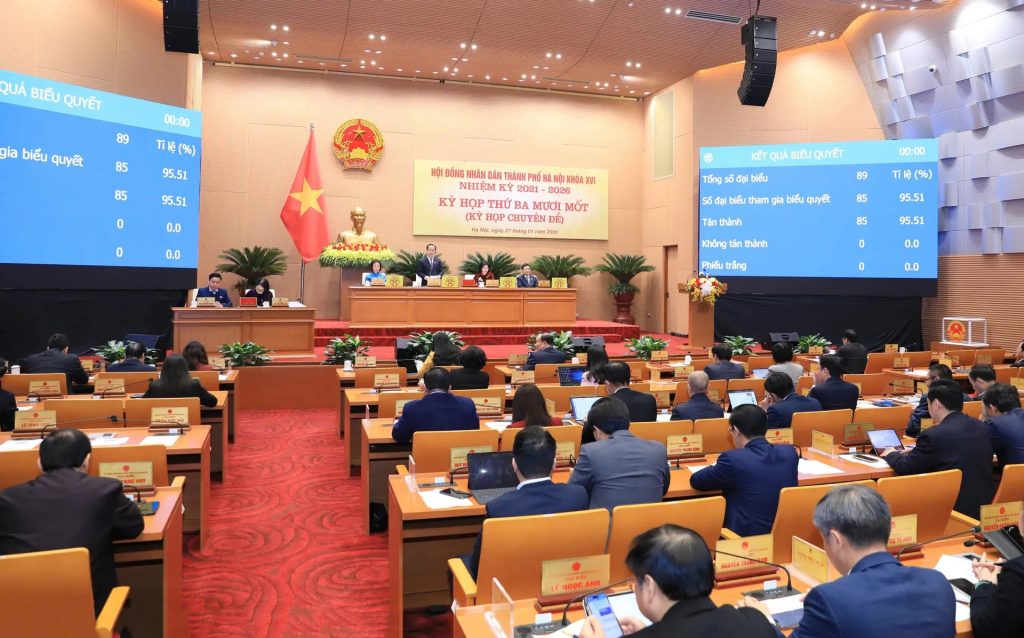
According to the Resolution, regarding the adjusted overall objectives for housing development, areas within wards and communes of the historic inner city will strictly limit the development of apartment buildings in newly invested commercial housing and social housing projects (except for projects involving renovation, reconstruction of apartment buildings, and resettlement housing), in order to minimize population growth and infrastructure overload.
In addition, newly developed housing projects and urban areas must be planned and constructed in a smart, civilized, and modern manner, oriented toward green housing and smart cities, applying digital technologies and adapting to climate change. Urban areas and residential zones must be developed with synchronized social infrastructure (healthcare, education, community facilities) and technical infrastructure (water supply systems; stormwater and wastewater drainage systems and on-site wastewater treatment facilities; electric vehicle charging stations, etc.).
At the same time, the city will form and implement multifunctional urban area projects (including commercial housing, social housing, resettlement housing, and housing for high-tech human resources). Large-scale urban projects of strategic importance must be aligned with the Hanoi Capital Master Plan with a 100-year vision. Housing development must ensure equity, meet both new construction and renovation needs, and aim to improve residents’ quality of life, with uniform construction quality standards across all housing types.
The city will also focus on urban renovation, embellishment, and redevelopment projects, including the renovation and reconstruction of old apartment buildings, to ensure safety of lives and property, enhance urban landscapes, and promote sustainable development of the Capital. Resources will be prioritized to eliminate temporary and substandard housing, reduce semi-permanent housing, and support poor and near-poor households in building, repairing, and upgrading degraded housing to meet the “three solid criteria” (solid foundation, solid frame/walls, solid roof).
Notably, the Resolution clearly adjusts housing floor area development targets. During 2021–2030, Hanoi aims to develop 255 million square meters of housing floor area, equivalent to approximately 1,821,700 housing units, raising the average housing floor area to at least 40 m² per capita. For the 2031–2035 period, the city targets approximately 127.5 million square meters of additional housing floor area, creating development reserves for projects in the 2026–2030 period, and increasing average housing floor area to at least 45 m² per capita.
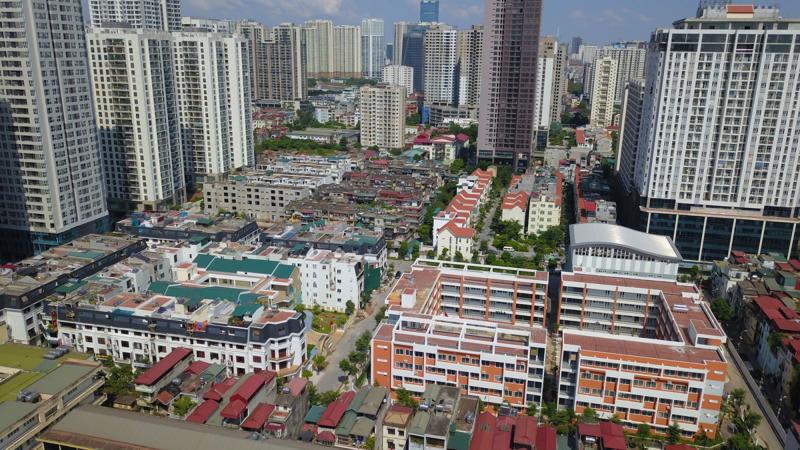
Regarding housing quality targets, by 2030, Hanoi aims for 100% permanent and semi-permanent housing citywide (both urban and rural areas), eliminating temporary and substandard housing.
For social housing, during 2021–2030, the city aims to develop at least 144,000 units (approximately 24,000 units in 2021–2025 and at least 120,000 units in 2026–2030); by 2035, at least 500,000 social housing units are expected to be completed.
The use purposes of social housing will be diversified and expanded, allowing flexible conversion among social housing, commercial housing, resettlement housing for urban redevelopment, public service housing, and rental social housing through the City Development Investment Fund, in accordance with Decree No. 302/2025/ND-CP of the Government.
For commercial housing, Hanoi aims to complete at least 180 million square meters of floor area, equivalent to approximately 1,122,200 housing units. Commercial housing and new urban area projects must adhere to smart, modern, green, and climate-adaptive development standards, with synchronized social and technical infrastructure.
For resettlement housing, the city will develop multifunctional resettlement urban areas. During 2021–2030, approximately 13.8 million square meters of floor area will be completed, equivalent to nearly 200,000 units.
Regarding renovation and reconstruction of old apartment buildings, during 2026–2030, Hanoi aims to complete the renovation and reconstruction of apartment buildings classified as requiring demolition, totaling approximately 1.5 million square meters of floor area (around 20,000 apartments). By 2035, the city targets completion of renovation, embellishment, and redevelopment for all 2,160 old apartment buildings.
For self-built housing by residents, the city encourages construction and renovation to permanent standards. During 2021–2030, self-built housing floor area is forecast to increase by approximately 45 million square meters, equivalent to around 300,000 houses. Housing support programs will continue for policy beneficiaries, poor and near-poor households, and households in disaster-prone areas.
By 2030, the minimum housing floor area is targeted at 8 m² per capita, in line with social housing rental standards under Decree No. 100/2024/ND-CP.
For 2026–2030, approximately 1,492.5 hectares of land are planned for social housing and multi-purpose housing development, alongside land for armed forces housing, worker accommodation, housing for experts, talents, and high-tech human resources.
With regard to the demand for state budget capital and other funding sources for housing development by each planning period, the total capital requirement for housing development during the 2021–2030 period is estimated at VND 2,779,282 billion, of which commercial housing accounts for approximately VND 2,001,004 billion, multi-purpose housing approximately VND 321,902 billion, social housing for the armed forces approximately VND 52,562 billion, housing self-built by households and individuals approximately VND 384,103 billion, and renovation and reconstruction of apartment buildings approximately VND 19,711 billion (calculated solely based on housing construction investment costs).

 Zalo
Zalo Webchat